
Henley-Young-Patton Release Paths
Henley-Young-Patton Juvenile Justice Center is a county juvenile detention center, not an adult Hinds County jail. Its official description covers short-term care while a youth awaits court study, disposition, transfer, placement, or another Youth Court recommendation. A departure may return the youth to a guardian and community. It may also carry out a court-ordered program placement or a transfer to another jurisdiction or agency. Only the specific authorized case record can show which result applies.
The word “release” needs care here. A youth who leaves the building is not necessarily free of court conditions or agency oversight. A transfer ends the stay at Henley-Young-Patton but begins custody or placement elsewhere. A return to a guardian may include Youth Court terms. The center should never be treated as a source for a public list of released juveniles. Ask the authorized case contact for the actual disposition, handoff, and next instructions.
| Possible departure | Authorized confirmation |
|---|---|
| Return to guardian | Guardian, attorney, and Youth Court direction |
| Program or placement | Youth Court order and placement contact |
| Agency transfer | Sending and receiving authorized contacts |
| Jurisdictional transfer | Attorney and courts or agencies involved |
Confirm a Juvenile Release
The correct lookup is not the current Hinds adult inmate query. Youth Court material has separate confidentiality rules, and the ICE locator does not include minors. The MDOC adult offender search is also not a substitute for a juvenile case channel. A public no-match in any of those systems says nothing reliable about whether a youth remains at Henley-Young-Patton, returned to a guardian, or moved to another authorized placement.
An authorized person should gather the youth's full legal name, case or cause number, hearing date, attorney information, and relationship to the youth. Do not publish those details. Then use this limited sequence:
- Contact the youth's guardian and attorney for the latest authorized placement or release direction.
- Call Henley-Young-Patton and be ready to establish identity and authority to receive information.
- Use the correct Hinds Youth Court channel for the case, hearing, disposition, or placement order.
- If a transfer occurred, ask the authorized sending contact which agency or placement received the youth.
- Follow the court and receiving agency's privacy process rather than requesting an adult booking release record.
Public access may be limited even when a record exists. Confidentiality protects the youth; it does not mean the authorized family, attorney, court, and center lack a record. If a caller is not entitled to details, staff may only give general routing or decline confirmation. That response should not be treated as evidence of release.
Henley-Young-Patton Release Contact
The official county center page supplies the facility address and phone. Use the number for authorized routing and current procedure. The center may require proof of identity, relationship, or case authority before discussing a youth. A guardian or attorney should ask what documents are needed before arriving or seeking a record. Public-record rules do not cancel juvenile confidentiality.
As of the July 26, 2026 research date, Tyree D. Jones was identified as Hinds County Sheriff; his office operates the adult jail paths, while Henley-Young-Patton remains a separate county juvenile channel.
Henley-Young-Patton Juvenile Justice Center
940 East McDowell Road
Jackson, MS
Phone: 601-985-3000
Case channels
Guardian or authorized family contact
Youth's attorney
Hinds County Youth Court
Authorized center staff
The official Henley-Young-Patton page is the source for the center's role, capacity, age range, address, and phone. Confirm current procedures directly because placement and access depend on the individual Youth Court matter.
The Hinds County Sheriff directory image below gives broader detention context, but Sheriff Records is not presented as a replacement for the juvenile center or Youth Court.
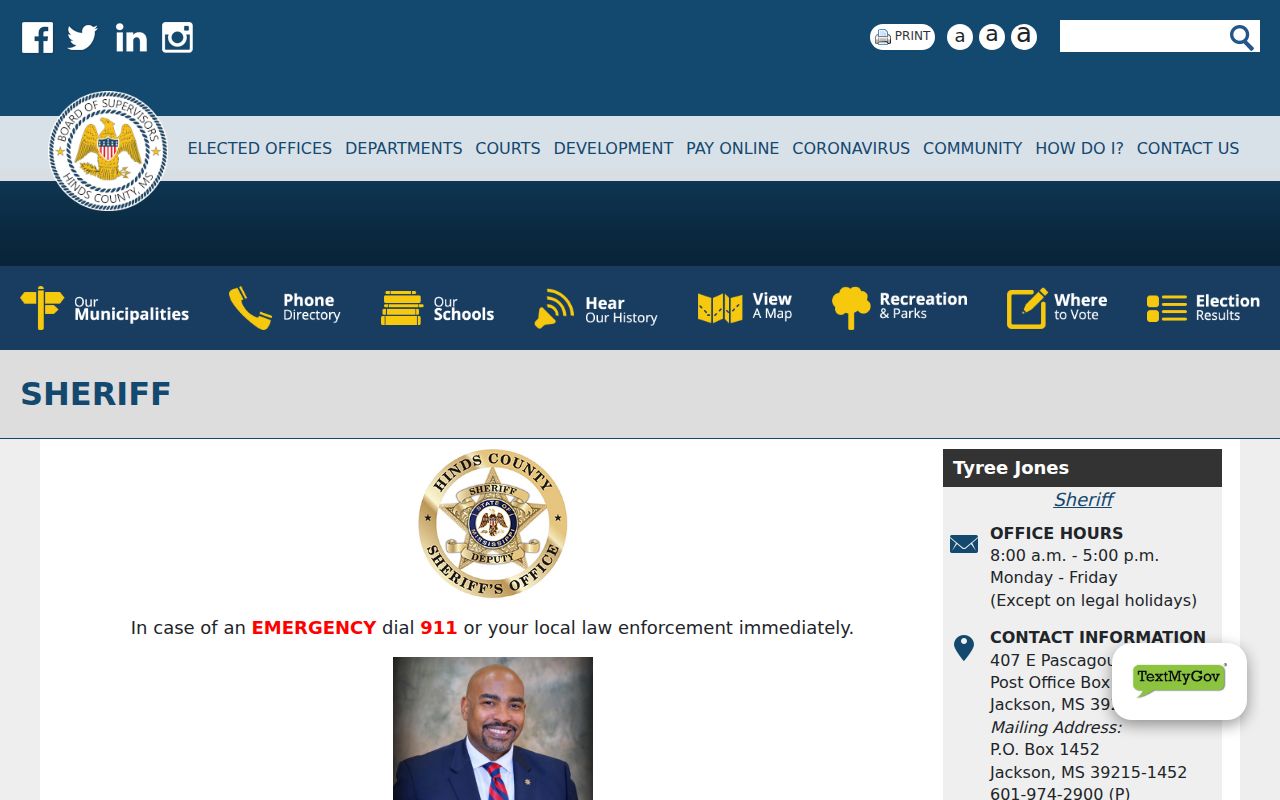
The distinction between adult detention contacts and the juvenile center helps keep confidential youth questions in the correct channel.
Note: Call first and ask what proof of authority is required before requesting a youth's placement or release information.
Henley-Young-Patton Youth Custody
The county describes Henley-Young-Patton as an 84-bed center for ages 12 through 17. Its role is short-term care pending study, a hearing, disposition, placement, transfer, or another Youth Court recommendation. Those figures explain why adult jail assumptions fail. A youth's stay is linked to a juvenile case and placement process rather than an ordinary adult jail roster and public booking-photo workflow.
A public page should not turn those facts into a list of children. Names, photographs, detailed dispositions, and exact placement data may be restricted. The proper record user is an authorized guardian, attorney, or court-connected person following the case procedure. Even then, the court or center controls what can be released and how identity is verified.
Juvenile Transfers and Detainers
Research on Hinds adult facilities documents that another warrant, jurisdiction, or immigration authority can affect an adult release. That angle must be localized carefully for Henley-Young-Patton. The ICE public locator expressly excludes minors, so it cannot be offered as a way to search for a youth. No current Hinds ICE contract or 287(g) agreement was verified, and no claim should be made that the adult detainer example describes this center's youth cases.
If an authorized record says a youth transferred to another agency or jurisdiction, the guardian or attorney should ask the Youth Court and center which receiving contact is permitted to confirm the next placement. A transfer is not a community release. The receiving record may remain confidential. Public silence, a declined phone confirmation, or absence from an adult system cannot resolve the youth's status.
- Disposition
- The Youth Court's resolution or direction in the case.
- Placement
- A court-directed setting or program after the center stay.
- Transfer
- A handoff to another authorized agency or jurisdiction.
- Guardian release
- A return to an authorized guardian, subject to the actual court direction.
Juvenile Release Location Context
Hinds custody operates through several distinct locations. Adult detention includes Raymond, Jackson Detention Center, and the county/state work facility. Jackson police also use a short city holding workflow. Henley-Young-Patton stands apart as the county juvenile center. Broader adult facility moves, including the 2023 transfer of about 200 Raymond detainees and construction reported in 2026, should not be projected onto a youth case without an authorized record.
The local lesson is to name the right institution and court. “Hinds jail” is too vague for a juvenile inquiry. Ask whether the matter is in Youth Court, whether Henley-Young-Patton is the authorized current or former placement, and which person can receive protected details. Location changes should be documented through the court and case contacts, not guessed from adult facility news.
Juvenile Release Record Limits
Mississippi public-record principles begin with access to public records, but specific confidentiality rules and court orders can limit juvenile material. A records custodian may withhold protected details or confirm only a process. The adult jail-docket statute and Hinds current inmate query are not promises of public youth release data. A narrow authorized request should identify the case and the requester's legal relationship, then ask the court or center what record and access process applies.
When information is lawfully shared, focus on the facts needed for care and compliance: the effective court direction, who accepted the youth, the date of the authorized handoff, the next hearing or reporting instruction, and the approved contact. Do not republish a youth's name, image, address, allegations, or disposition. A protected juvenile record serves the case and the young person; it is not an adult release feed.
The Hinds County court directory lists several court systems, but Youth Court is the relevant route for this center. A criminal filing visible through an adult court portal should not be assumed to reveal a juvenile placement. The guardian or attorney can identify the cause number, judge or court contact, and next authorized step without making the youth's case public. When a court order directs placement, the order explains the authority. The center or receiving agency confirms the actual handoff through protected channels.
Records can also differ in purpose. A center custody entry may document admission and departure, while the Youth Court file contains the hearing and disposition. A receiving placement keeps its own intake. An authorized inquiry should ask which custodian owns each fact rather than requesting “all release records” from the adult Sheriff's unit. This protects confidentiality and reduces the chance of a false no-record response.
No official public recent-release list, photo archive, or adult-style inmate detail was identified for Henley-Young-Patton. That absence is appropriate to state plainly. It must not be filled with names from social posts, news reports, or private databases. Case-specific care instructions belong with the guardian, attorney, court, and authorized center staff.
For adult Hinds releases, the Hinds County released inmates page uses county jail, MDOC, court, and notification systems. That adult path should be kept separate from every Henley-Young-Patton inquiry.