
Hinds Release Date Meanings
MDOC uses the exact label “Tentative Release Date.” Its guide defines that date as the anticipated release from incarceration after adjustments for earned time or credit for time served. It is a forecast within the current state computation. It is not a court promise, parole-hearing date, proof of a past exit, or guarantee that no detainer will operate.
An actual Hinds County release date is the date and time the jail, MDOC facility, or other custodian completed the transaction. A county jail docket can record how and when a county stay ended. A state discharge certificate or MDOC record can establish the corresponding state event. A court order supplies authority but may precede the actual exit.
Hinds Release Dates by Custody
A person held before trial normally has no sentence-based release date. Bond can permit release, but another warrant, hold, or court condition may keep the person in custody or cause a transfer. A person serving a county sentence needs the sentencing order, jail credit, and jail docket. A person serving a state sentence needs the MDOC computation. Federal and immigration custody use separate records.
| Custody | Date source | Key limit |
|---|---|---|
| Pretrial Hinds detention | Court order, bond record, jail docket | No fixed sentence date; other holds may apply |
| County sentence | Sentencing order, jail credit, Sheriff Records | No published Hinds county good-time rule was found |
| MDOC sentence | Inmate Search, timesheet, MDOC Records | Public field is tentative, not actual |
| Parole or ERS | MDOC and supervision records | Physical release is not final discharge |
| Federal sentence | BOP locator and federal docket | Release from BOP may lead to supervision or another custodian |
| ICE custody | ICE locator and immigration record | Recent-result scope and exact-match limits apply |
Find Hinds Inmate Release Dates
Begin with identity and custody. Collect the full name, date of birth when lawfully available, booking or MDOC number, case number, facility, and sentence county. The Hinds current-inmate query can test present county custody, but a no-match does not establish release. The MDOC public search can test current state custody and show a tentative date on a detail record.
- Identify whether Hinds County, Jackson police, MDOC, BOP, USMS, or ICE is the last known custodian.
- For county custody, read the court order and ask Sheriff Records for the jail docket and jail-credit record.
- For state custody, search the full name or MDOC ID and confirm Hinds in the county-of-conviction details.
- Record the exact “Tentative Release Date,” present location, sentence details, and search date.
- Ask MDOC Records for the timesheet, jail-credit calculation, and discharge record when the public result is unclear.
- Check parole, ERS, other cases, warrants, and detainers before treating the date as community release.
The full county custody and records-request sequence is available through the Hinds County released inmates search. At the July 26, 2026 research date, the official sheriff page listed Tyree D. Jones as Hinds County Sheriff. For a state record dispute, MDOC Records is at P.O. Box 24388, Jackson, MS 39225, phone 601-933-2889, and MDOCRecordsDepartment@mdoc.state.ms.us.
MDOC Hinds Tentative Release Date
The MDOC search accepts first name, last name, and MDOC ID. Results can display a photo, identity details, entry date, current location and unit, sentence count and length, offense, sentence date, county of conviction, and Tentative Release Date. Hinds is not a search input. It is checked within the sentence result as the county of conviction.
Research verified MDOC Inmate Search as a current-inmate locator, not a released or discharged archive. A no-match cannot be translated into a past release. It may reflect spelling, no MDOC custody, a data issue, or a record no longer presented. Actual release or discharge must be confirmed through MDOC Records, a discharge certificate, a parolee match, or another source tied to the event.
The captured representative MDOC detail demonstrates where the exact tentative-date field appears.
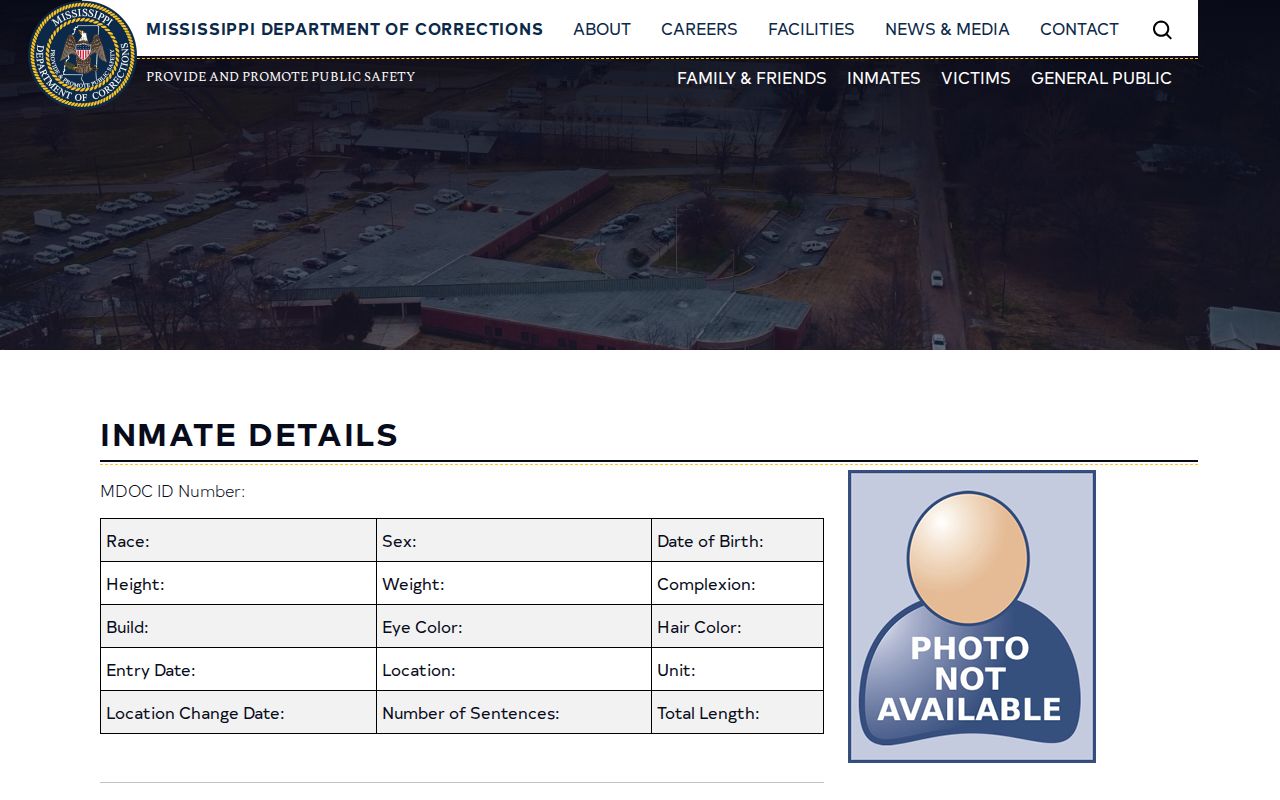
The detail’s sentence and location context should be read with the date instead of treating the forecast as a stand-alone promise.
Hinds Release Dates and Earned Time
Mississippi Code §47-5-138 supplies the earned-time framework for applicable sentences imposed after June 30, 1995. It permits 4.5 days of earned-time allowance for each 30 days served, with total allowance capped at 15 percent of the sentence. This produces the familiar maximum “85 percent” arithmetic for that one mechanism. It is not a universal rule that every person leaves prison at exactly 85 percent.
Eligibility, offense and sentence law, conduct, performance, exclusions, forfeiture, jail credit, and other sentences all matter. Release under this provision can be earned-release supervision. Section 47-5-138 states that a person on ERS keeps inmate status and remains under MDOC jurisdiction until sentence expiration. Physical release and full discharge therefore have different dates.
Hinds Jail Credit Changes Dates
The MDOC handbook describes qualifying pre-sentence or pretrial county jail credit. The time must fall between the relevant offense and earliest sentence date, relate to the cause for which the person is incarcerated, and not be counted twice. MDOC seeks the credit from the county of conviction. Someone moved among jails should tell the case manager so missing time can be checked.
Allowable jail time is deducted from the earliest sentence date to establish the sentence begin date. A Hinds jail record can therefore change a state forecast even after transfer. Use the Hinds public-record request for the county jail dates, then obtain the sentencing order and MDOC timesheet. If the person served only a county sentence, do not apply §47-5-138 mechanically. No published Hinds-specific county good-time or weekend-release rule was located.
Hinds Parole Eligibility Dates
Parole eligibility is another clock. Mississippi Code §47-7-3 is offense- and date-specific and contains exclusions. Earned or good time does not reduce the time required for parole eligibility under that statute. Mississippi Code §47-7-18 calls for hearings for specified groups and permits other eligible releases without a hearing only when the statutory conditions are met.
An eligibility date is not a Board grant and is not an actual exit date. The parolee search can show active parole after release, while the Board record addresses hearing or decision questions. MDOC’s guide also warns that parole and ERS eligibility dates are not guaranteed release dates. Avoid flat percentage rules when the governing offense date, classification, and sentence have not been checked.
Why Hinds Release Dates Change
A tentative date represents the current computation. New facts or corrected records can move it. The change may come from credit, sentence structure, conduct, a court action, a supervision event, or another custodian. The right source depends on the cause.
| Factor | Possible effect | Record to check |
|---|---|---|
| County jail credit | Moves the sentence begin date when qualifying time is added | Hinds custody dates and MDOC timesheet |
| Concurrent or consecutive terms | Changes how multiple sentences overlap or follow each other | Judgment and MDOC computation |
| Earned-time accrual or forfeiture | Moves the tentative incarceration release date | MDOC timesheet and institutional record |
| Parole process | Creates eligibility or conditional release, not a guaranteed date | Board and MDOC records |
| New order or corrected judgment | Changes sentence or credit inputs | Court docket and amended order |
| Warrant or detainer | Can turn an expected community release into continued custody or transfer | Jail log and receiving-agency record |
| Revocation or new conviction | Can add custody or alter supervision | Court and MDOC records |
Hinds Release Order Timing
A federal order involving the Hinds jail system described a release log that separates the date a person became entitled to release, the time and manner the jail received the order, the actual release time, the elapsed processing time, and any detainer or other reason for continued detention. It provides a strong local model for asking the right date question.
The order date should not be copied as the physical exit date. Ask for both. If a detainer led to a handoff, record the receiving authority as well. This distinction is especially important after a bond order or sentence completion, when another case can continue custody.
MDOC Release Date Logistics
MDOC’s family and friends guide says the state release process can take 30 to 45 days and requires a discharge certificate before release. The case manager informs the inmate of the date and verifies travel plans. A bus ticket may be purchased to the destination or nearest city, but MDOC does not purchase out-of-state travel.
These are state-prison logistics. They are not promises about the hour or exit process at Raymond Detention Center. Hinds research found no official adult county release time, weekend rule, or routine pickup procedure. Call the facility before planning transportation.
Confirm Hinds Actual Release Dates
Confirm an anticipated event with the agency that holds the person. For a Hinds county sentence or pretrial case, identify the right tribunal through the Hinds court system directory, then compare its order with the jail-docket release date and time. For MDOC, obtain the state release or discharge record. For parole or ERS, verify the supervision status separately from physical release.
Mississippi SAVIN/VINELink can send notice of release, transfer, or other custody changes. Register for the particular person and agency before the expected event, then check the message with the source. The VINELink Release Check explains the Hinds-specific event path. A transfer alert does not mean freedom, and a delayed alert should not override the custodian’s transaction record.
Date-stamp each lookup and keep the case or booking number. A forecast can move, while the actual transaction record should identify the custodian, event time, release type, and receiving agency when a handoff occurred.
- Tentative release date
- MDOC’s current forecast after applicable adjustments.
- Parole eligibility
- A date when the parole framework may permit review or release, subject to law.
- Actual release
- The date and time the custodian completes exit or handoff.
- Maximum discharge
- The expected endpoint without early-release allowances as defined in MDOC guidance.